Coconut Cream Separation Troubleshooting: Solids, Fat, Water and Process Variables
Coconut cream separation looks simple on a flow diagram: mill, extract, screen, heat, separate, standardize, pack. On the plant floor, it is rarely that clean.
A separator that ran smoothly yesterday may suddenly show unstable cream recovery, thin cream, high sediment, excess sludge discharge, poor skimming, or variable fat content from batch to batch. Operators often adjust temperature, feed rate, back pressure, or bowl settings first. Those controls matter. But when coconut solids, fiber fines, protein, oil droplets, and water-binding polysaccharides are not behaving consistently, mechanical adjustment alone can become a moving target.
Enzymereach supports coconut processors with enzyme systems designed for extraction, viscosity control, clarification support, and batch consistency. As an enzyme supplier for coconut processing, our focus is practical: help plants reduce separation stress, protect throughput, and make cream recovery more predictable.
What unstable coconut cream separation usually looks like
Cream separation issues can appear in several ways:
- Cream phase is too thin or inconsistent in fat content
- Heavy sediment forms in cream tanks after holding
- Separator sludge discharge increases unexpectedly
- Skim phase carries visible fat or cream haze
- Feed viscosity rises and separator capacity drops
- Screen or filter load increases upstream or downstream
- Operators need frequent manual corrections during a run
- Product appearance shifts from smooth and creamy to grainy or watery
These symptoms often overlap. A plant may see high sediment and low cream recovery in the same batch, or good separation at startup followed by deterioration as feed composition changes.
The key is to separate mechanical limits from raw material and slurry behavior.
Why coconut cream separation is difficult
Coconut is not a neutral liquid. It is a complex emulsion containing fat droplets, proteins, insoluble fiber, fine shell or testa particles, cell wall fragments, water-soluble carbohydrates, and mineral content. Small shifts in raw material maturity, pressing conditions, extraction ratio, particle size, or heat history can change how the feed behaves in a separator.
The main process variables include:
- Particle size distribution after grinding or disintegration
- Water addition and extraction ratio
- Holding time before separation
- Temperature profile before the separator
- Feed viscosity and entrained air
- Upstream screening efficiency
- Bowl loading and discharge frequency
- Cleanliness of heat exchangers, screens, and separator internals
- Natural variation in coconut solids and oil content
When these variables combine, the separator is no longer just separating fat and water. It is also managing suspended solids, gels, fine fiber, and changing viscosity.
Cause 1: Excess fine solids entering the separator
Fine coconut solids are one of the most common causes of unstable cream recovery. Larger particles are usually removed by screening. The more difficult fraction is fine fiber and cell wall material that remains suspended in the milk stream.
These fines can:
- Increase separator sludge volume
- Carry fat into the discharge phase
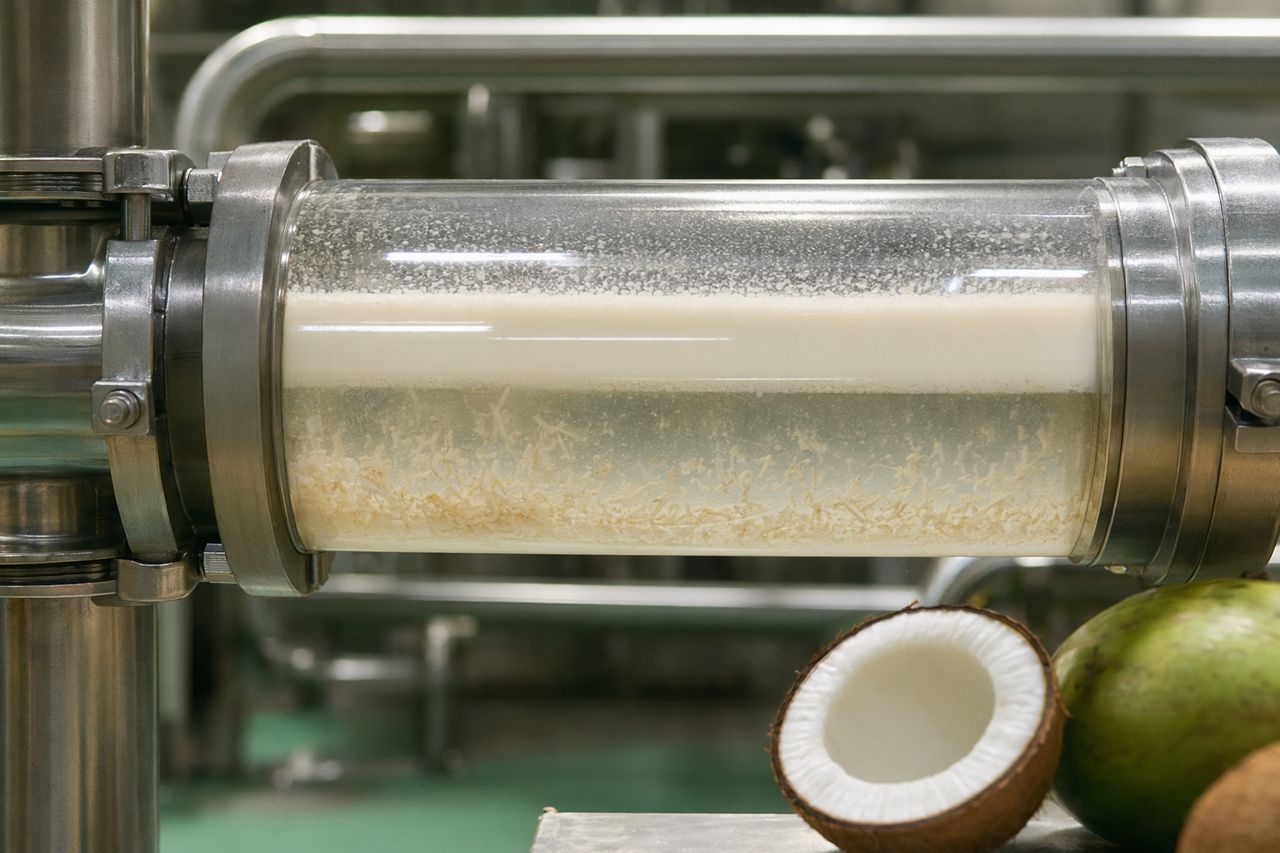
- Create sediment in cream after storage
- Interfere with clean phase boundary formation
- Increase downstream filtration load
- Make cream texture feel sandy or chalky
If the plant responds only by tightening screens, filtration may become the new bottleneck. Enzymatic pretreatment can help by modifying selected fiber and cell wall components so the slurry flows and separates more consistently.
Cause 2: Viscosity is too high or too variable
Coconut milk viscosity affects every separation decision. High-viscosity feed reduces the effective settling behavior inside the separator and can lower throughput. Variable viscosity is even more disruptive because the line may not stay in its optimized operating window.
Common contributors include:
- Over-milling or excessive fine particle generation
- High solids extraction without enough flow control
- Long holding times before separation
- Temperature variation between batches
- Natural hydrocolloid and fiber content in the coconut meat
- Incomplete release or uneven breakdown of cell wall material
A lower, more controlled viscosity can support smoother pumping, better heat transfer, reduced bowl stress, and more predictable cream separation. The objective is not to make the product watery. The objective is to control the slurry so fat separation happens reliably.
Cause 3: Fat droplets are not separating cleanly
Coconut fat can remain dispersed when the feed is overloaded with solids, proteins, fiber fragments, or unstable emulsifying material. Even with correct separator settings, fat may carry into the skim stream or become trapped in sludge.
This can reduce cream yield and create inconsistent fat standardization.
Plants should review:
- Feed temperature at separator inlet
- Time between extraction and separation
- Pump shear and air incorporation
- Screen performance before the separator
- Sludge discharge pattern
- Fat in skim and fat in sludge trends
- Visual condition of cream after holding
Enzyme selection can support upstream release and viscosity reduction, but it must be aligned with the intended cream specification. Over-treatment, wrong enzyme class selection, or poor process timing may create new texture or stability problems.
Cause 4: Sediment forms after cream is already separated
Sediment is frustrating because the separation step may appear acceptable at first. The cream exits with the right look, then deposits form during storage, blending, or filling.
Possible causes include:
- Fine insoluble particles passing through separation
- Protein-fiber complexes settling over time
- Uncontrolled upstream particle size
- Incomplete hydration before separation
- Thermal aggregation caused by uneven heating
- Poor tank agitation design or dead zones
In these cases, the troubleshooting target is not only the separator. It is the full path from grinding to holding tank.
A practical enzyme program may reduce the amount of settling material by improving extraction uniformity and reducing problematic suspended solids before they reach the separator.
Cause 5: Water addition and extraction ratio are inconsistent
Water addition is often adjusted to chase extraction yield or target solids. But inconsistent dilution changes viscosity, fat concentration, separator loading, and cream phase behavior.
If the extraction ratio changes from batch to batch, operators may see:
- Variable separator feed density
- Changing cream fat content
- Inconsistent skim clarity
- Different sludge discharge volumes
- Unstable final standardization requirements
Enzymatic processing does not replace extraction control. It works best when the plant has defined water addition, temperature, residence time, and mixing conditions. Stable inputs allow enzyme performance to translate into stable separation.
A practical troubleshooting sequence for coconut cream separation
Before changing multiple parameters at once, isolate the issue in a controlled sequence.
1. Map the symptom
Document what is actually failing:
- Low cream recovery
- High skim fat
- High sludge fat
- Heavy sediment
- Separator vibration or overload
- Unstable cream fat
- Poor cream texture
- Excess filtration pressure
Each symptom points to a different root cause.
2. Check upstream solids control
Review grinder condition, screen integrity, screen size, feed consistency, and slurry recirculation. Excess fines often start before the separator.
3. Track viscosity at operating temperature
A room-temperature check may not represent separator behavior. Compare batches at the actual separation temperature and feed solids level.
4. Review heat and hold time
Coconut milk can change during holding. Delays, uneven heating, or repeated heat exposure can alter viscosity and emulsion behavior.
5. Measure phase losses by trend
Track fat in cream, skim, and sludge over time. A single reading helps less than a trend connected to feed condition and process settings.
6. Trial enzyme support under plant-like conditions
Bench results should be validated against realistic solids content, time, temperature, mixing, and downstream separation. The goal is a process window the production team can run, not a lab-only improvement.
Where enzymes can support cream separation
Enzymereach enzyme systems are used to support process behavior before separation. Depending on the plant objective, the program may be designed to help with:
- Improved coconut milk extraction from disintegrated meat
- More controlled viscosity before separation
- Reduced suspended fiber impact
- Lower filtration load after separation
- More consistent cream recovery
- Smoother batch-to-batch standardization
- Better handling of seasonal or supplier-related raw material variation
Enzymes are not a universal fix. They are most effective when selected for the plant’s raw material, equipment, temperature profile, residence time, and product specification.
What Enzymereach looks at before recommending an enzyme program
To recommend a practical solution, Enzymereach reviews the production reality, not just the product label.
Key inputs include:
- Coconut meat condition and source variation
- Grinding or milling method
- Extraction temperature and water ratio
- Solids content before separation
- Existing screen and filtration setup
- Separator type and operating limitations
- Current cream fat target
- Sediment and sludge observations
- Cleaning frequency and fouling points
- Batch or continuous operation constraints
This allows the enzyme recommendation to fit the line instead of forcing the line to fit the enzyme.
Production signs that an enzyme review may be worthwhile
Consider a Enzymereach technical review if your coconut processing plant is seeing:
- Separator capacity limited by viscosity rather than mechanical throughput
- Frequent operator adjustment to maintain cream fat
- Sediment complaints in cream or coconut milk products
- High sludge losses with visible fat carryover
- Filter or screen blinding after extraction
- Inconsistent results between coconut lots
- Higher-than-expected rework or standardization correction
- Yield loss that cannot be explained by raw material alone
The strongest opportunities usually appear where extraction, viscosity, and separation problems occur together.
Build a steadier separation window
Stable coconut cream separation depends on more than separator settings. It depends on how the coconut matrix is opened, how fines are managed, how viscosity is controlled, and how consistently the feed reaches the separator.
Enzymereach helps coconut processors evaluate these variables and build enzyme-supported process windows for better flow, cleaner separation behavior, and more dependable cream recovery.
Need support with coconut cream separation troubleshooting? Use the on-site request a quote form to share your process challenge, current separation issue, and target cream specification. Enzymereach will review the application and respond with a practical enzyme recommendation for your line.