Export Market Trends for Coconut Milk, Cream and Value-Added Coconut Ingredients
For coconut processors, export growth is no longer just a sales story. It is a production-control story.
Buyers are asking for cleaner labels, tighter texture targets, stable mouthfeel, repeatable fat performance, and formats that move efficiently through international supply chains. At the same time, plants must manage natural variation in coconut maturity, kernel composition, fiber load, and seasonal raw-material quality.
Enzymereach works as an enzyme supplier for coconut processing focused on practical plant outcomes: better extraction behavior, controlled viscosity, lower separation stress, reduced filtration load, and more consistent batches for coconut milk, cream, and downstream ingredient formats.
What export buyers are prioritizing now
Global demand for coconut-based ingredients remains broad, but the requirements are becoming more specific. Importers, private-label brands, beverage manufacturers, dessert producers, and foodservice distributors are looking beyond basic supply availability.
They increasingly evaluate coconut suppliers on:
- Consistent creaminess across production lots
- Stable viscosity for filling, pumping, blending, and end-use formulation
- Low sediment and fiber carryover in finished products
- Efficient separation behavior during clarification, cream standardization, or downstream processing
- Reliable performance in UHT, retort, frozen, chilled, and aseptic formats
- Documentation discipline, including traceability, process controls, and specification repeatability
- Flexible formats, from bulk coconut cream to concentrated bases, powders, blends, and culinary ingredients
For processors, this means the export market rewards plants that can convert variable coconuts into predictable commercial ingredients.
Coconut milk and cream: still the export anchor
Coconut milk and coconut cream remain the core value drivers for many processing plants. Demand is supported by plant-based beverages, Asian cuisine, vegan desserts, premium sauces, ready meals, bakery fillings, and foodservice applications.
However, export buyers do not view all coconut milk or cream as interchangeable. They often specify narrow targets for fat content, texture, color, flavor profile, and stability. A product that performs well in one local dish may not meet the filling speed, emulsion behavior, or shelf-life expectation of an export customer.
This is where production control matters. Enzyme-assisted processing can help plants manage the way coconut tissue breaks down, releases extractable solids, and moves through separation and filtration stages. The objective is not to make the process complicated. The objective is to make each batch less dependent on raw-material inconsistency.
Value-added coconut ingredients are changing plant requirements
Export growth is not limited to canned coconut milk. Processors are expanding into higher-value formats, including:
- Coconut cream bases for desserts and beverages
- Concentrated coconut milk ingredients
- Coconut culinary bases for sauces and curries
- Coconut fat-emulsion systems for plant-based foods
- Coconut ingredient blends for bakery and confectionery
- Coconut solids streams for powders or fiber-managed products
- Functional coconut bases used by beverage and meal manufacturers
These formats place heavier demands on upstream processing. A plant producing commodity cream can tolerate more variability than a plant supplying a beverage manufacturer that requires precise flow behavior and low sediment formation.
When value-added formats become part of the export strategy, viscosity control, fiber management, and separation efficiency move from technical details to commercial requirements.
The production implications behind export specifications
Export customers may phrase requirements in commercial language: smooth texture, clean pour, no grit, stable body, uniform appearance, and consistent performance. Inside the plant, those requirements translate into measurable process pressures.
1. Extraction must be efficient without overloading the line
Processors want strong recovery from coconut kernel, but aggressive mechanical treatment can increase fine particles, raise viscosity, and make downstream clarification harder. Enzymatic support can help improve release while reducing the need to push the process into a high-load operating window.
2. Viscosity must be controlled, not guessed
High viscosity can slow pumping, reduce heat-transfer efficiency, complicate homogenization, and create filling variation. Low or unstable viscosity can create a product that fails buyer expectations. The target is not simply thinner or thicker. The target is controlled viscosity that fits the product format.
3. Separation and filtration load affect throughput
Fiber, suspended solids, and unstable emulsified fractions can create bottlenecks. Filtration load, centrifuge behavior, membrane stress, and sediment control all affect plant uptime. For export-oriented production, predictable separation performance protects delivery schedules.
4. Batch consistency protects customer confidence
A buyer may accept one excellent batch, but they renew contracts based on repeatability. Variability in raw coconut source, maturity, extraction conditions, and solids handling can show up as inconsistent cream line, texture drift, or filling issues. Process aids that stabilize the upstream extraction profile can reduce downstream correction work.
Where enzyme solutions fit in coconut processing
Enzyme programs for coconut processing are typically evaluated by their operational effect, not by theory. Plant teams want to know whether a solution helps them produce a more consistent product with less process friction.
Common production goals include:
- Improved coconut solids and cream extraction behavior
- More manageable slurry and milk viscosity
- Lower fiber-related stress during screening or filtration
- Improved clarification behavior before final formulation
- Better batch-to-batch consistency when raw material changes
- Reduced rework linked to texture, sediment, or processing instability
- More predictable transfer, heating, filling, or concentration performance
Enzymereach supports these objectives with application-focused enzyme selection and process-fit guidance for coconut plants. The best program depends on raw material, extraction method, thermal profile, target format, equipment constraints, and buyer specification.
Export formats and what they demand from the plant
Canned and retort coconut milk
This format rewards stable texture, consistent fat dispersion, and reliable thermal-process behavior. Plants must pay attention to solids management, emulsion quality, and viscosity before filling.
Aseptic coconut milk and cream
Aseptic lines require disciplined flow behavior and clean upstream processing. Excessive fiber or unstable viscosity can affect heat treatment, holding, filling, and final appearance.
Frozen coconut cream
Frozen formats must maintain performance after thawing. Separation, graininess, and inconsistent body can become more visible after distribution stress.
Bulk foodservice coconut cream
Foodservice buyers need practical performance: pourability, spoonability, sauce compatibility, and consistent handling across kitchens or commissaries.
Ingredient bases for manufacturers
Manufacturers using coconut ingredients in beverages, desserts, bakery, sauces, and plant-based foods often test for application performance. They expect repeatability because their own finished product depends on it.
What processors should monitor as export demand matures
Coconut processors planning for export growth should watch several market signals:
- More private-label buyers demanding tighter specifications
- Growth in plant-based and dairy-alternative applications
- Higher interest in clean, minimally complicated ingredient statements
- Greater scrutiny of sediment, separation, and mouthfeel
- Demand for bulk formats that fit industrial formulation lines
- More audits around process control, traceability, and consistency
- Pressure to improve yield while controlling energy and filtration cost
The commercial opportunity is real, but the margin is often made or lost inside the process line.
Practical questions for plant teams
Before adjusting an enzyme program or designing one for export-focused products, plant teams should align around practical questions:
- Which product format is driving the highest margin?
- Where is the current bottleneck: extraction, viscosity, separation, filtration, heating, filling, or rework?
- How much raw-material variability is the plant absorbing each week?
- Which buyer complaints or internal rejects are linked to texture, sediment, or batch drift?
- What equipment constraints limit process changes?
- Which quality attributes must remain unchanged for customer acceptance?
A good enzyme strategy starts with these production realities, not with a generic additive recommendation.
Watch the 1-minute explainer
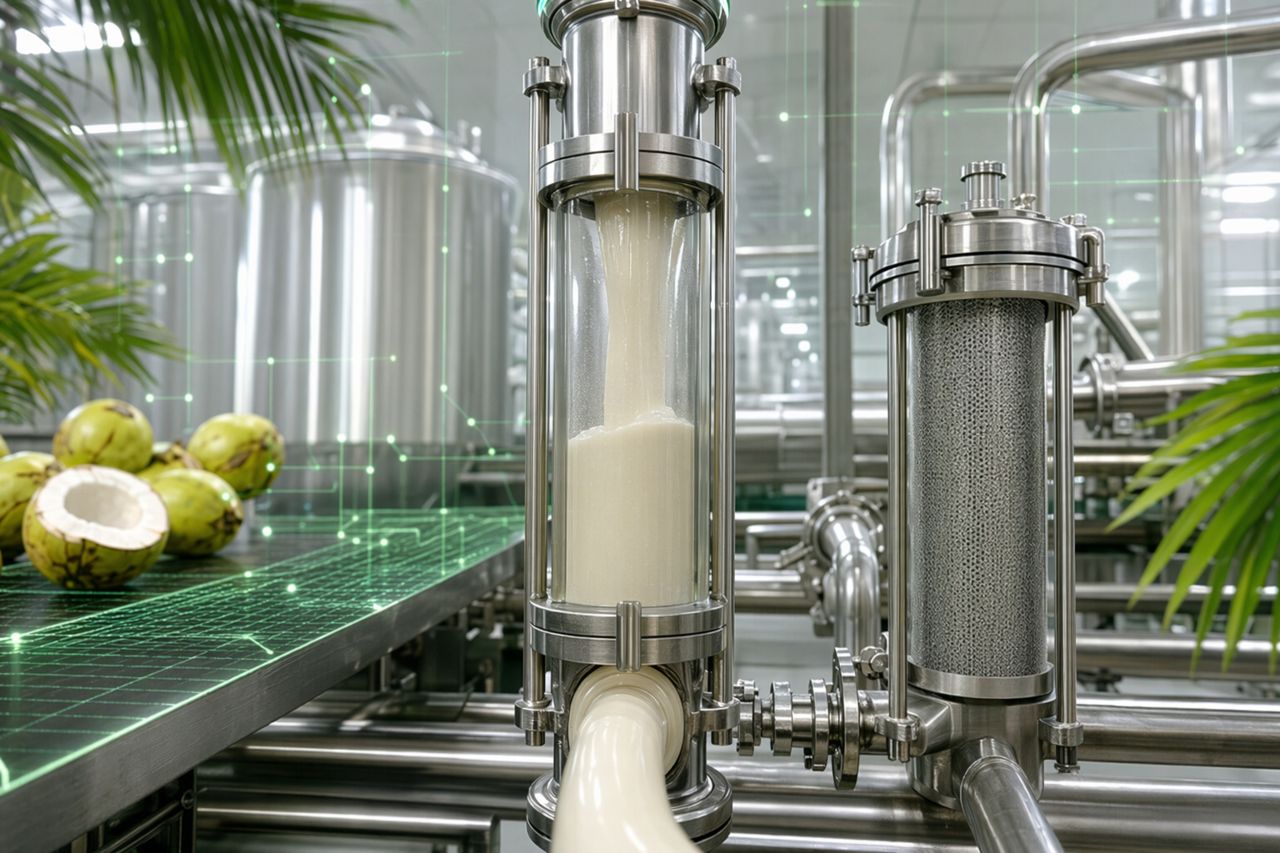
The embedded Enzymereach explainer shows how export specifications connect to extraction, viscosity, separation, and filtration load inside a coconut processing plant. It is designed for production, quality, and commercial teams reviewing export readiness.
Enzymereach view: export growth favors controlled processors
The next phase of coconut ingredient growth will reward processors that can deliver both volume and control. Buyers want creamy, stable, plant-based coconut ingredients. They also want reliable supply, repeatable specifications, and products that perform in their own manufacturing environments.
For coconut plants, that means yield improvement cannot be separated from viscosity management, separation efficiency, and batch consistency. A well-matched enzyme program can help the line run with more control while supporting export product quality.
Request a quote
If your plant is developing coconut milk, cream, or value-added coconut ingredients for export markets, Enzymereach can help evaluate enzyme options around your process targets.
Request a quote through the on-site form and tell us your product format, current bottleneck, and desired processing outcome.