Where Coconut Milk Yield Is Lost: A Plant-Level Loss Map
For a coconut processing plant, yield loss is rarely one big event. It is usually a chain of small losses: rejected nuts, thick mash, under-opened cells, overloaded screens, cream trapped in fiber, unstable separation, and product held up by viscosity.
Enzymereach works as an enzyme supplier for coconut processing plants that need more controlled extraction, smoother flow, and repeatable batch behavior without turning the line into a laboratory project. This loss map is designed for production, engineering, QA, and procurement teams looking for practical places to recover value.
The short version: yield is lost when the process stops releasing, moving, or separating coconut solids efficiently
Coconut milk yield depends on how well the plant can:
- Receive consistent raw material
- Expose oil- and cream-bearing tissue during size reduction
- Release entrapped liquid from fiber
- Move slurry without excessive viscosity
- Screen without blinding
- Separate cream and aqueous phases cleanly
- Heat treat without creating downstream instability
Enzymes can support several of these steps by modifying the plant cell-wall materials that hold liquid, create viscosity, and increase filtration load. The best results come when enzyme use is positioned as a process control tool, not a last-minute additive.
1. Receiving: yield loss starts before the first cut
Raw coconut variation drives the first yield gap. Nut maturity, storage time, meat thickness, microbial condition, and dryness all affect extraction behavior.
Common loss signals
- High variation in kernel moisture
- More brittle or overly dry meat entering grinding
- Increased off-spec lots after storage delays
- Batch-to-batch swing in milk solids and fat recovery
Plant-level control points
Receiving should not only classify nuts by visual quality. It should also help production predict extraction behavior. If older or drier material is routed into the same program as fresher material, the plant may see higher fiber hold-up, thicker slurry, and lower milk release.
Enzymereach view: enzyme performance is more consistent when raw material variation is visible. Segmenting lots by process behavior helps plants choose the right treatment window instead of chasing yield losses after separation.
2. Dehusking and shelling: mechanical loss becomes process loss
Dehusking and shelling are not enzyme application points, but they influence the downstream line. Excessive breakage, foreign material, or inconsistent meat handling can increase sorting loss and slow feed preparation.
Where yield disappears
- Meat left attached to shell
- Physical damage causing unnecessary trimming
- Foreign material increasing rejection or rework
- Uneven feed into paring and washing
What to watch
A small increase in discarded meat at this stage can become a large production cost over a week. Track reject bins and trim loss by shift, not just by day, because operator technique and equipment condition often show up as hidden yield variation.
3. Paring and washing: surface cleanup can remove recoverable material
Paring is needed for color and quality, but aggressive removal takes usable coconut meat with it. Washing can also remove fine particles that would otherwise contribute to extractable solids, especially when handling is rough.
Common loss signals
- Thick paring peel streams
- White meat visible in peel waste
- Fine solids carried away in wash water
- Reduced solids entering grinding despite normal input weight
Production-minded check
Measure the relationship between paring waste and extracted milk yield. If paring becomes stricter due to color complaints, the plant may solve one quality issue while creating a larger yield penalty.
4. Grinding and milling: the cell-opening bottleneck
Grinding is one of the largest mechanical control points in coconut milk extraction. If the grind is too coarse, liquid remains locked in tissue. If it is too fine, the plant can create a thick slurry that increases pumping load, screen blinding, and separator stress.
Yield loss patterns
- Coarse particles leaving extraction still rich in cream
- Over-milled mash creating high viscosity
- Screens loading faster after mill adjustments
- Press cake or spent fiber still appearing wet and creamy
Where enzymes can help
Enzyme treatment can help loosen coconut cell-wall structure, supporting release of entrapped liquid and reducing the resistance that makes mash hard to move. This is especially valuable when the plant is trying to improve yield without grinding so aggressively that filtration suffers.
Best production question: are we losing yield because cells are not open enough, or because the slurry is too difficult to separate after we open them?
5. Extraction and mixing: recovery depends on contact, not just water addition
Extraction efficiency depends on temperature profile, water ratio, mixing intensity, contact time, and particle distribution. More water is not always the answer. It can increase volume, dilute the stream, and overload downstream evaporation or standardization.
Hidden yield losses
- Short contact time during high-throughput shifts
- Poor mixing in tanks with dead zones
- Inconsistent slurry temperature
- Recovered milk diluted beyond target economics
- Cream still retained in spent fiber
Enzyme-led opportunity
A controlled enzyme step can improve extraction by making the mash more responsive during mixing. The goal is not simply thinner product. The goal is better release, lower resistance in the slurry, and a more predictable feed to screening and separation.
6. Pressing: wet cake is a yield report in physical form
Spent coconut fiber tells the truth. If press cake is visibly creamy, oily, or wet, the plant is sending value into waste, animal feed, or low-value streams.
Loss map indicators
- High moisture in discharged fiber
- Visible white milk residue in cake
- Press pressure rising without better recovery
- Frequent press cleaning due to fiber compaction
Practical control points
- Check feed particle size before blaming the press
- Confirm mash viscosity before increasing pressure
- Review enzyme contact conditions before pressing
- Track cake condition by batch and raw material lot
Pressing harder can create equipment wear and still fail to recover entrapped milk if the mash structure is the real bottleneck.
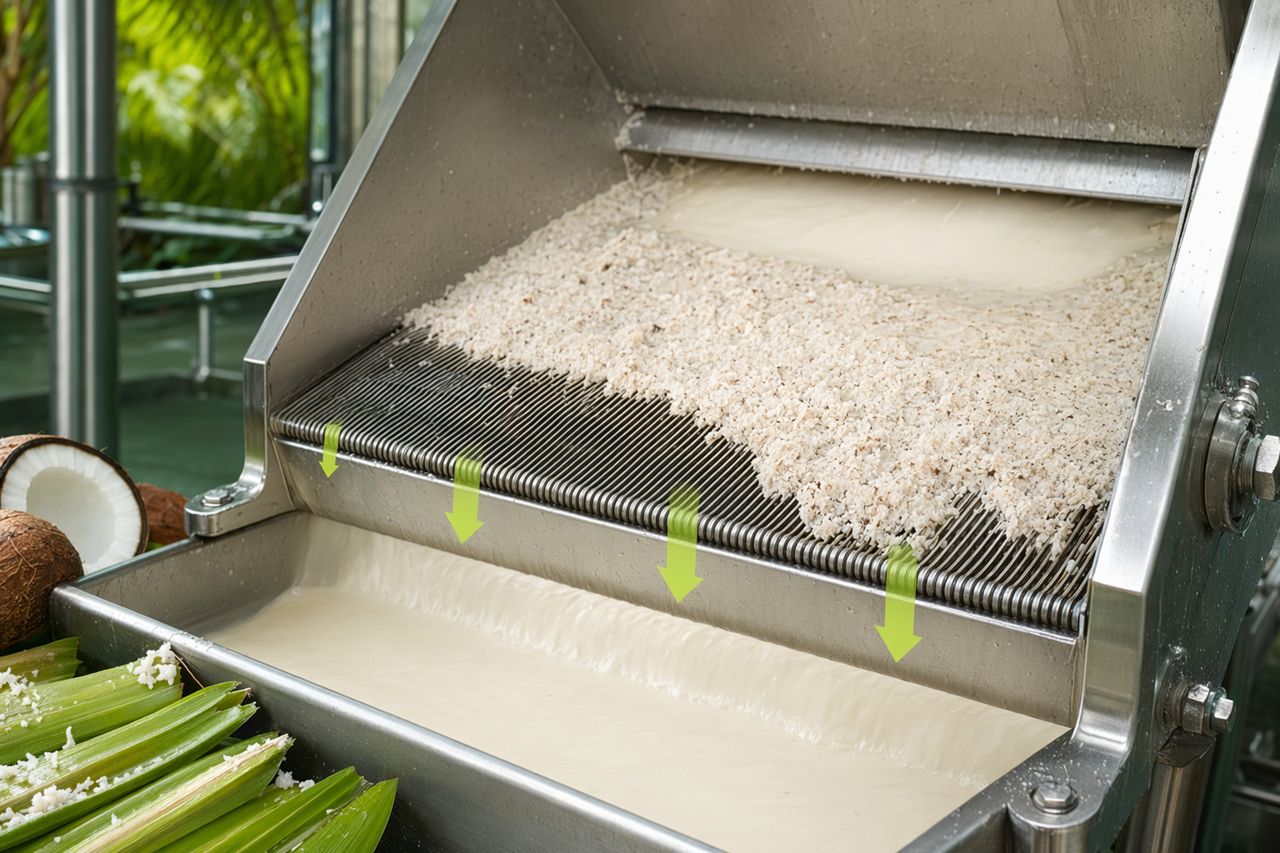
7. Screening and filtration: blinding turns yield into downtime
Screens and filters protect product quality, but they can also become yield loss points. When coconut fiber, fine particles, and viscous components overload the screen, the line slows. Operators may bypass, dilute, recirculate, or stop for cleaning.
Common symptoms
- Short screen run time
- Rising pressure before planned cleaning
- Product retained in fiber mats
- Excessive rinse losses during cleaning
- Variable downstream feed solids
Enzyme relevance
By helping manage fiber behavior and slurry viscosity, enzymes can reduce the load that reaches screening. Better flow can mean less retained milk, fewer interruptions, and more consistent feed to separators.
8. Separation: cream recovery depends on feed consistency
Centrifugal separation performs best with a stable feed. If viscosity, temperature, particle load, or solids distribution shifts, cream recovery becomes inconsistent. Yield may be lost as fat in the aqueous phase or as product retained in sludge.
Watch for
- Cream layer instability
- Excess solids in separator discharge
- Fat carryover into lighter phase
- Frequent separator cleaning
- Output swings after upstream grind changes
Control principle
Separation should not be asked to solve upstream inconsistency. A plant that stabilizes mash preparation, enzyme treatment, screening load, and feed temperature gives the separator a better chance to recover cream predictably.
9. Thermal processing: heat locks in both gains and mistakes
Thermal processing protects safety and shelf life, but it can also magnify upstream problems. A feed with unstable solids, excessive viscosity, or inconsistent fat distribution may create fouling, burn-on, flavor stress, or texture variation.
Yield-related heat issues
- More product held in heat exchangers during cleaning
- Fouling that shortens run length
- Increased rework from texture or separation defects
- Product loss during start-up and shutdown transitions
Why upstream enzyme control matters
The enzyme step must be designed to support extraction and flow before heat treatment. Once the product is thermally processed, upstream release and viscosity problems are no longer easy to correct.
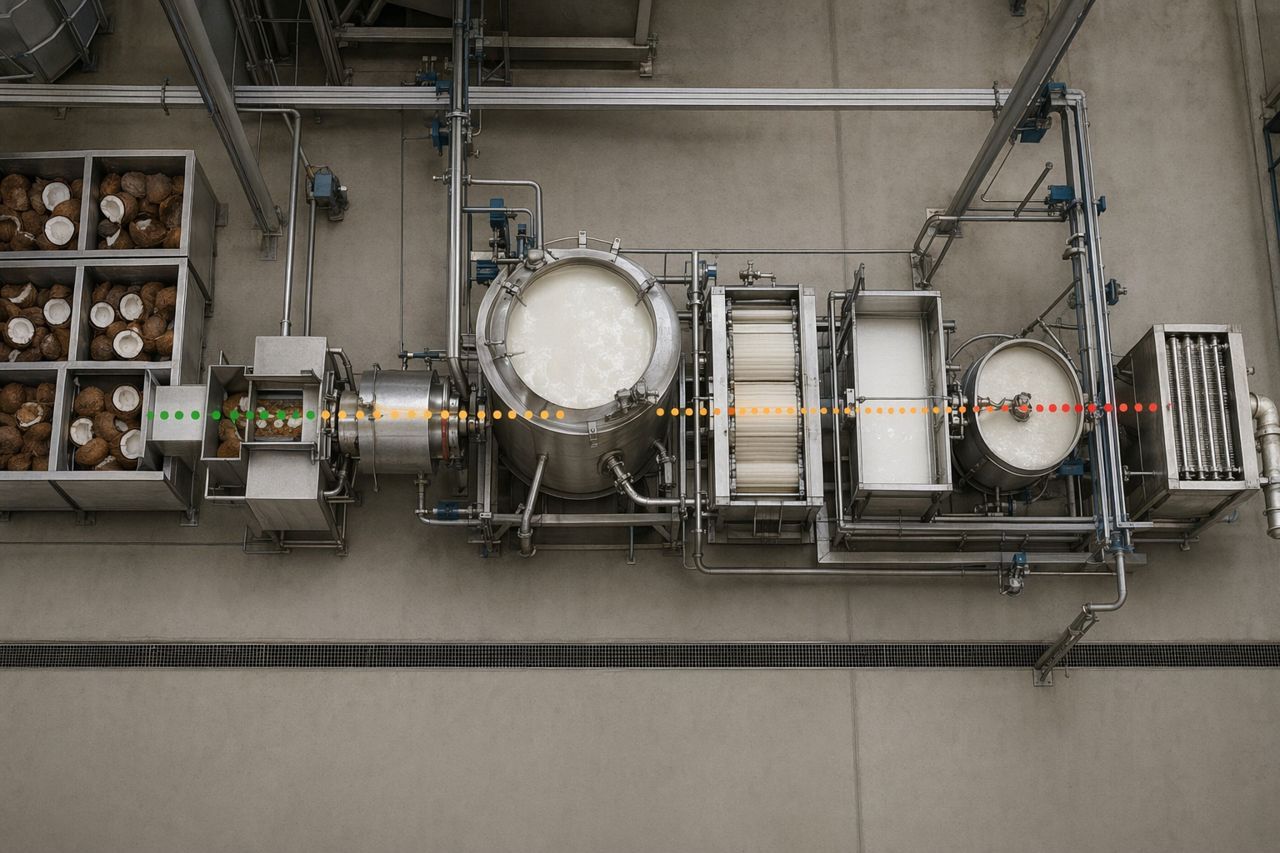
The plant-level loss map
| Process area | Typical yield loss | Operational impact | Enzyme-related opportunity |
|---|---|---|---|
| Receiving | Variable kernel quality | Batch inconsistency | Match treatment window to raw material behavior |
| Dehusking and shelling | Meat left behind or rejected | Lower usable input | Improve upstream sorting data for process planning |
| Paring and washing | Excess trim and fine solids loss | Less extractable mass | Protect usable meat before extraction |
| Grinding | Under-opened cells or over-thick slurry | Lower release or higher load | Support release without over-milling |
| Extraction | Cream retained in fiber | Lower milk recovery | Improve cell-wall breakdown and liquid release |
| Pressing | Wet, creamy cake | Value leaving in waste stream | Reduce fiber hold-up before pressing |
| Screening | Blinding and retained product | Downtime and rinse loss | Lower filtration load and stabilize flow |
| Separation | Fat carryover and sludge loss | Variable cream yield | Feed separators with more consistent viscosity and solids |
| Thermal processing | Fouling and rework | Shorter runs and product loss | Lock in a stable upstream process |
How to investigate yield loss without disrupting production
A practical yield project should start with a controlled map, not a full-line overhaul.
Step 1: define the loss stream
Pick one measurable loss stream first:
- Wet press cake
- Screen reject
- Separator discharge
- Cleaning rinse loss
- Rework after heat treatment
Step 2: connect the loss to upstream behavior
Ask what changed before the loss appeared:
- Raw material lot
- Grind profile
- Extraction temperature
- Hold time
- Mixing intensity
- Water ratio
- Screen condition
- Separator feed temperature
Step 3: run a plant-aligned enzyme trial
The right trial should fit existing equipment where possible. It should compare production-relevant outcomes such as:
- Milk yield per input mass
- Press cake dryness and appearance
- Slurry flow behavior
- Screen run time
- Separator stability
- Cleaning frequency
- Batch-to-batch consistency
Step 4: evaluate total plant value
Yield is important, but it is not the only value. A plant may also gain from:
- Shorter filtration delays
- More stable separator operation
- Lower product retention in waste streams
- Fewer operator interventions
- More predictable standardization
- Improved throughput during peak runs
Where Enzymereach fits
Enzymereach supports coconut processors with enzyme solutions selected for industrial coconut milk and coconut cream production priorities: extraction, viscosity control, separation support, filtration load reduction, and batch consistency.
We help production teams evaluate where enzymes belong in the process, what operating window is practical, and which performance indicators matter commercially. The aim is simple: recover more value from the same coconut input while protecting plant uptime.
Request a quote
If your plant is seeing wet fiber, heavy screen load, unstable separation, or inconsistent coconut milk yield, Enzymereach can help assess the loss point and recommend an enzyme approach suited to your line.
Request a quote through the on-site form and include your process stage, product type, and main production constraint.