Coconut Milk Quality Defects: Sediment, Rancid Notes, Phase Separation and Color Drift
For a coconut processing plant, coconut milk quality is not only a sensory issue. It affects line speed, filtration pressure, separator behavior, filling accuracy, heat-transfer efficiency, customer complaints, and release decisions.
Enzymereach works as an enzyme supplier for coconut processing with a production-first focus: improve extractability, manage viscosity, reduce avoidable solids load, and support consistent batches without forcing operators to redesign the entire plant.
This defect dictionary is built for QA, production, and technical procurement teams who need a practical way to connect visible defects with likely process causes and corrective actions.
How to Use This Defect Dictionary
When a coconut milk defect appears, avoid treating it as a single-point failure. Most defects come from a chain of conditions:
- Raw material maturity and handling
- Kernel grinding profile
- Water ratio and extraction temperature
- Holding time before heat treatment
- Enzyme contact conditions, if used
- Separation and filtration load
- Homogenization settings
- Thermal process impact
- Packaging oxygen exposure
- Storage temperature and time
The goal is to isolate the defect pattern, protect release decisions, and adjust the process before the issue becomes a repeating complaint.
1. Sediment at the Bottom of Packs or Tanks
What it looks like
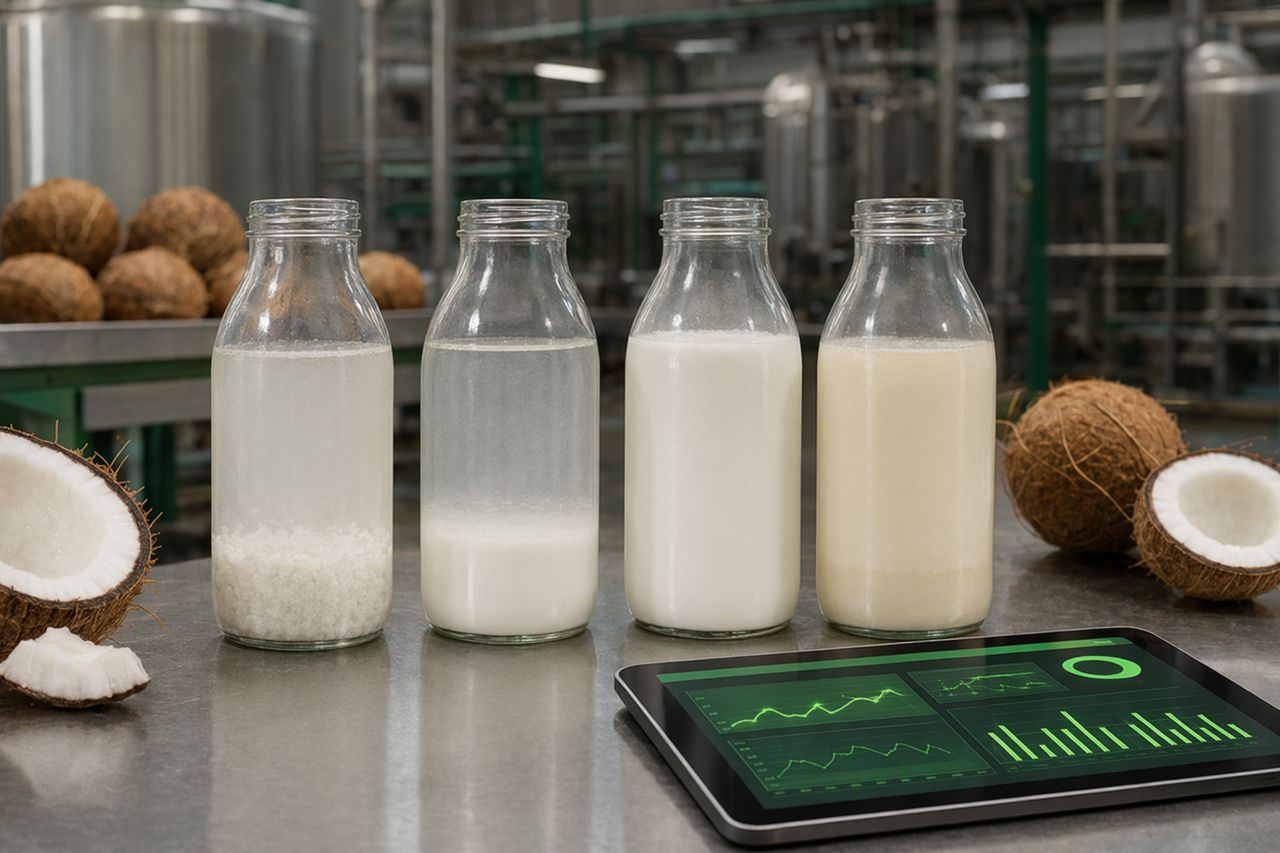
Sediment appears as a pale, gritty, beige, or fibrous layer at the bottom of a sample bottle, tote, or finished package. In severe cases, the product pours unevenly or leaves visible particles on strainers and screens.
Why it matters
Sediment creates a quality signal that buyers often interpret as poor extraction, weak filtration, or unstable formulation. In operations, it can increase downstream filtration load, raise cleaning frequency, and create inconsistent solids transfer between batches.
Common plant causes
- Coarse grinding or uneven comminution of coconut kernel
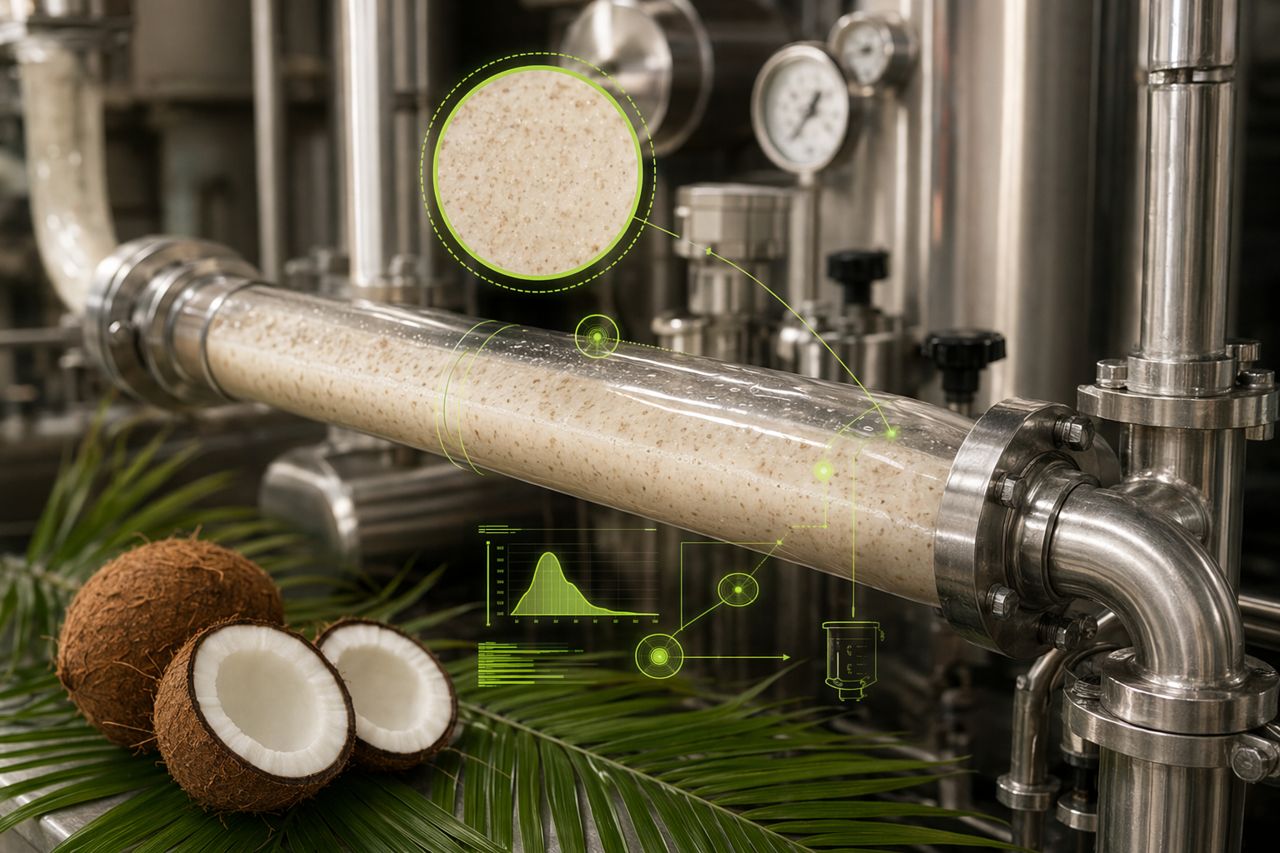
- High insoluble fiber carryover after extraction
- Weak separation efficiency due to viscosity or solids overload
- Inconsistent screen integrity or bypass during filtration
- Over-aggressive agitation that redistributes settled fines before sampling
- Long holding time that allows heavy particles to settle before filling
Where enzymes can help
A targeted enzyme program can help loosen the coconut matrix and reduce the amount of extractable material trapped in fibrous solids. The practical benefit is not just higher extraction; it is more controllable slurry behavior. Better breakdown of structural plant material can reduce stubborn fine solids, support cleaner separation, and ease filtration pressure.
What to check before changing the recipe
- Compare sediment from the extraction tank, post-separator stream, and finished pack
- Review grinder screen condition and particle size consistency
- Track differential pressure across filters by batch
- Check if sediment worsens during long holds or only after thermal processing
- Confirm whether the sediment is fibrous, proteinaceous, oily, or mineral-like
Production note
Do not assume all sediment is removable by tighter filtration. Finer filters may catch more solids, but they can also reduce throughput, increase pressure, and raise cleaning demand. Fixing extract behavior upstream is often more efficient than forcing the filter to become the process correction point.
2. Rancid, Soapy, or Stale Notes
What it smells or tastes like
Rancid defects can present as soapy, sharp, fatty, stale, cardboard-like, bitter, or painty notes. In coconut milk, even a small oxidation or lipolysis signal can stand out against the expected creamy, fresh profile.
Why it matters
Flavor drift is a commercial risk. It may not show up as a visible defect during production, but it can trigger delayed complaints after distribution. Rancid notes also create uncertainty around shelf-life claims and customer acceptance.
Common plant causes
- Poor raw coconut handling before processing
- Extended holding of grated coconut or coconut milk before heat treatment
- High oxygen exposure during transfer, blending, or storage
- Ineffective temperature control during intermediate holding
- Residual lipase activity from raw material or microbial load
- Incomplete cleaning of lines, tanks, gaskets, or dead legs
- Oxidative stress from excessive air incorporation during pumping or agitation
Where enzymes fit — and where they do not
Enzymes used for extraction and texture control should be selected and applied so they support process performance without creating unwanted flavor release. The objective is controlled action, not uncontrolled breakdown. Enzymereach helps plants align enzyme selection with hold time, thermal kill step, and the desired finished sensory profile.
Enzymes are not a substitute for poor raw material handling, slow sanitation response, or uncontrolled oxygen pickup. If rancid notes appear, the first investigation should include raw material freshness, time-temperature exposure, and post-process oxygen control.
What to check
- Compare fresh extract, post-heat product, and retained shelf-life samples
- Review coconut storage time and condition before grinding
- Check for air entrainment at pumps, bends, and tank returns
- Verify cleaning effectiveness in fat-contact surfaces
- Monitor whether the note appears immediately or develops over storage
Production note
Rancidity is often a timing defect. A process that tastes clean at filling can fail later if oxygen exposure, residual activity, or microbial stress was not controlled upstream.
3. Phase Separation: Cream Layer, Watery Layer, or Ring Formation
What it looks like
Coconut milk may show a cream plug at the top, a watery layer below, floating fat droplets, ring formation at the pack shoulder, or visible instability after storage. Some separation is expected in minimally stabilized systems, but uncontrolled separation damages buyer confidence.
Why it matters
Phase separation affects pour quality, appearance, dosing behavior, and downstream manufacturing use. For foodservice and industrial buyers, inconsistent cream distribution can change fat delivery, mouthfeel, and recipe performance.
Common plant causes
- Inconsistent fat-to-solids balance between extraction batches
- Viscosity too low to suspend fat and fine solids
- Homogenization pressure or temperature not matched to product structure
- Protein and fiber matrix disrupted by heat or pH stress
- Poor emulsifier or stabilizer hydration, where used
- Overloaded separation equipment or inconsistent recirculation
- Long storage under temperature cycling
Where enzymes can help
In coconut milk, enzyme programs can support more uniform extraction and help manage the plant fiber network that influences viscosity and suspension. The right approach can reduce batch-to-batch swings that make homogenization and separation harder to control.
The key is balance. Too little structural modification may leave the product heavy with fibrous solids. Too much can thin the system or change mouthfeel. Enzymereach focuses on practical process windows that protect creaminess while improving flow and separation behavior.
What to check
- Measure viscosity trend batch by batch using your plant’s standard QC method
- Compare separation after hot fill, cooling, and storage simulation
- Review homogenization temperature, pressure stability, and valve condition
- Check extraction water ratio and solids carryover
- Confirm whether the issue is fat separation, sedimentation, or both
Production note
Phase separation is rarely solved by one setting alone. It is usually a combined outcome of extraction, solids load, fat droplet size, viscosity, heat history, and storage stress.
4. Color Drift: Grey, Brown, Yellow, or Dull Appearance
What it looks like
Color drift may appear as a dull grey tone, brown tint, yellow cast, uneven shade between batches, or darkening after storage. In premium coconut milk, the expected appearance is clean, creamy, and consistent.
Why it matters
Color is a fast customer acceptance cue. Even when flavor is acceptable, color variation can lead to rejected deliveries, extra COA questions, and tighter customer audits.
Common plant causes
- Raw coconut age, maturity, or shell/skin carryover
- Excessive heating or long thermal exposure
- Oxidation during holding and transfer
- Metal contact or poor equipment condition in sensitive areas
- Suspended fine particles changing light reflection
- Browning reactions accelerated by time, temperature, and solids concentration
Where enzymes can help
Improved extraction and fiber management can help reduce uncontrolled particulate carryover, which influences opacity and light scattering. A cleaner, more predictable extract is easier to standardize. However, enzymes cannot reverse heat damage or poor raw material selection. The best results come when enzyme use is integrated with raw material grading, controlled heating, and tight hold times.
What to check
- Compare color before and after heat treatment
- Inspect raw material for testa, shell fragment, or aged kernel carryover
- Review residence time in hot zones
- Check oxygen exposure in open tanks or turbulent returns
- Confirm whether color drift is immediate or develops over storage
Production note
Color drift often points to upstream discipline. If the same recipe produces different shades across shifts, look first at raw material handling, extraction conditions, and thermal exposure.
5. Viscosity Swings Between Batches
What it looks like
One batch pumps smoothly and fills accurately. The next runs thick, loads filters, slows heat exchange, or creates foaming and surging. Another may become too thin and separate quickly.
Why it matters
Viscosity is a production variable, not only a sensory characteristic. It affects transfer time, pump load, separator efficiency, filter life, homogenization behavior, and fill-weight consistency.
Common plant causes
- Variable coconut maturity and kernel composition
- Uneven grind size and extraction intensity
- Inconsistent extraction temperature or contact time
- Solids carryover from fiber and fine particles
- Water ratio drift during extraction or standardization
- Uncontrolled enzyme contact conditions
- Delays before heat treatment or stabilization
Where enzymes can help
A well-selected enzyme program can make viscosity more predictable by modifying the plant matrix in a controlled way. For production teams, the value is steadier flow, reduced filtration strain, and fewer operator interventions during transfer and separation.
What to check
- Trend viscosity against extraction yield, filtration pressure, and separator performance
- Review whether thick batches also show higher sediment
- Check time from extraction to heat treatment
- Confirm that dosing, mixing, and temperature conditions are consistent
- Compare operator notes by shift and raw material lot
Production note
Viscosity control should be tied to the actual plant bottleneck. The right target is not always the lowest viscosity; it is the viscosity that allows stable extraction, separation, heat transfer, and finished product quality.
6. Filtration Load and Short Filter Runs
What it looks like
Filters blind early, pressure rises quickly, flow drops, cleaning becomes more frequent, and operators compensate by slowing the line or increasing bypass risk.
Why it matters
Filtration load is a direct uptime issue. It increases labor, water, cleaning chemistry, product hold time, and variation between the first and last part of a batch.
Common plant causes
- High insoluble fiber load from extraction
- Fine particle generation from over-grinding
- Poor pre-screening before finer filtration
- High viscosity reducing flow through the filter bed
- Inconsistent enzyme action or insufficient mixing
- Solids shocks from tank bottoms or poorly managed transfers
Where enzymes can help
Enzymes can support cleaner extraction by changing how coconut solids release cream and liquid. The practical goal is lower strain on filters and separators, not simply a different lab number. When the upstream slurry is more controlled, downstream equipment can run closer to plan.
What to check
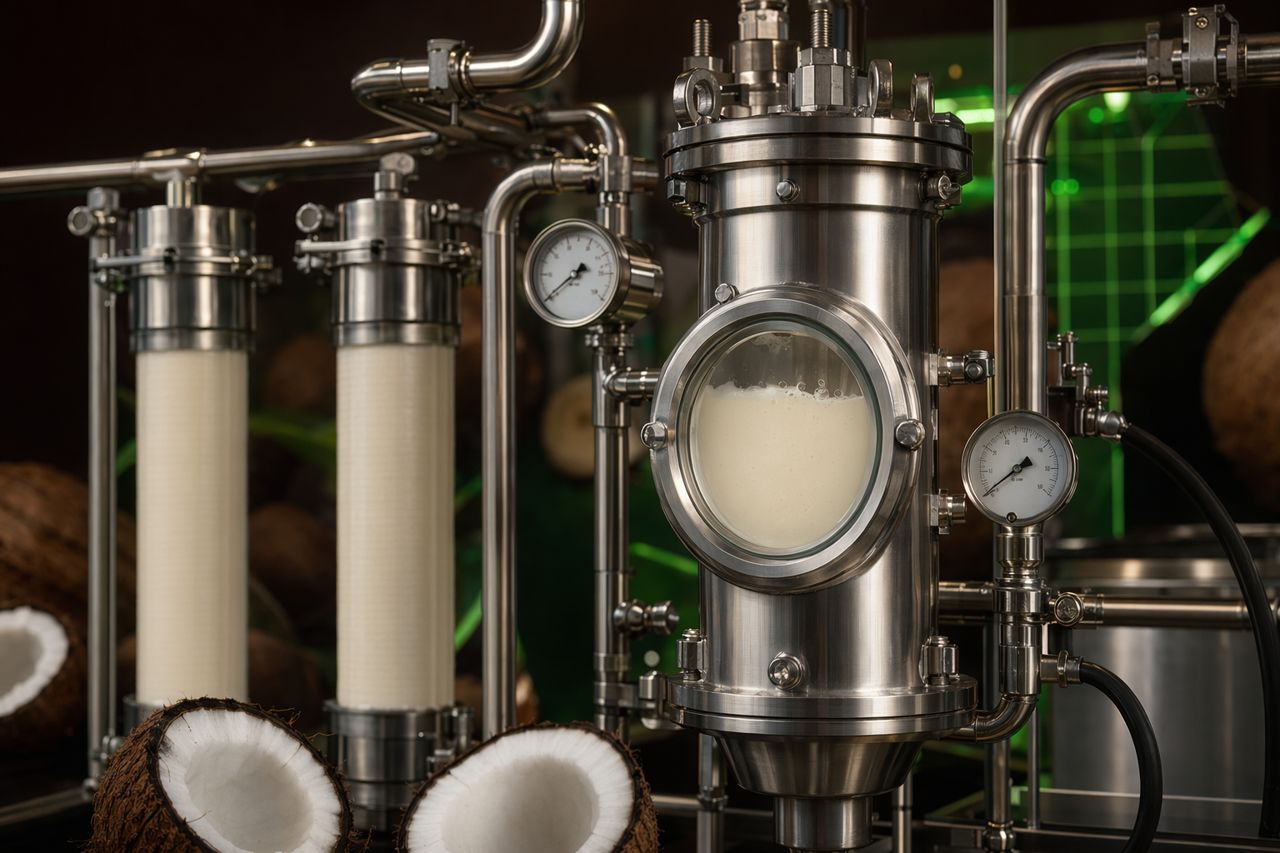
- Pressure rise curve across the filter during each batch
- Solids profile before and after pre-screening
- Transfer practice near tank bottoms
- Whether filter blinding correlates with specific raw material lots
- Cleaning interval and any decline in restored flow after cleaning
Building a Corrective Action Plan
When defects repeat, use a structured review rather than adjusting one variable at a time without records.
Step 1: Map the defect location
Identify where the defect first appears:
- After grinding
- After extraction
- After enzyme contact, if used
- After separation
- After filtration
- After heat treatment
- After homogenization
- After storage
Step 2: Link quality data to production data
Useful correlations include:
- Sediment vs. filtration pressure
- Viscosity vs. separator stability
- Flavor drift vs. holding time
- Color drift vs. heat exposure
- Phase separation vs. fat and solids balance
- Filter life vs. raw material lot
Step 3: Confirm the process window
For enzyme-supported coconut processing, define a practical operating window for:
- Product temperature during contact
- Mixing quality
- Contact time
- Order of addition
- Hold time before thermal step
- Compatibility with separation and filtration
- Finished sensory target
Step 4: Validate at plant scale
A bench trial can guide selection, but plant behavior determines value. Watch pump load, filter pressure, separator stability, yield movement, creaminess, sediment, and finished-pack stability.
What Enzymereach Brings to Coconut Milk Plants
Enzymereach supports coconut processors that need enzyme solutions aligned with real production constraints. Our focus is not a generic ingredient pitch. It is helping technical and procurement teams select an enzyme approach that fits the line, the raw material, and the finished product target.
We help plants evaluate enzyme programs for:
- Coconut milk and coconut cream extraction
- Viscosity control in high-solids streams
- Reduced filtration load
- Improved separation behavior
- Better batch consistency
- Support for stable, creamy product profiles
- Practical integration with existing thermal and mechanical steps
The best enzyme solution is the one your operators can run consistently.
Request a Quote
If your plant is seeing sediment, phase separation, viscosity swings, heavy filtration load, or inconsistent coconut milk quality, Enzymereach can help review the process target and recommend a suitable enzyme program.
Use the on-site request a quote form and include your product type, current process flow, main defect, and desired production outcome. We will respond with a practical next step for evaluation.